A Short History of Pancakes Around the World
From ancient griddle cakes to Dutch pannenkoeken and Hungarian palacsinta, explore how pancakes became a family favorite in so many different countries.
- 4 min read
- Guide
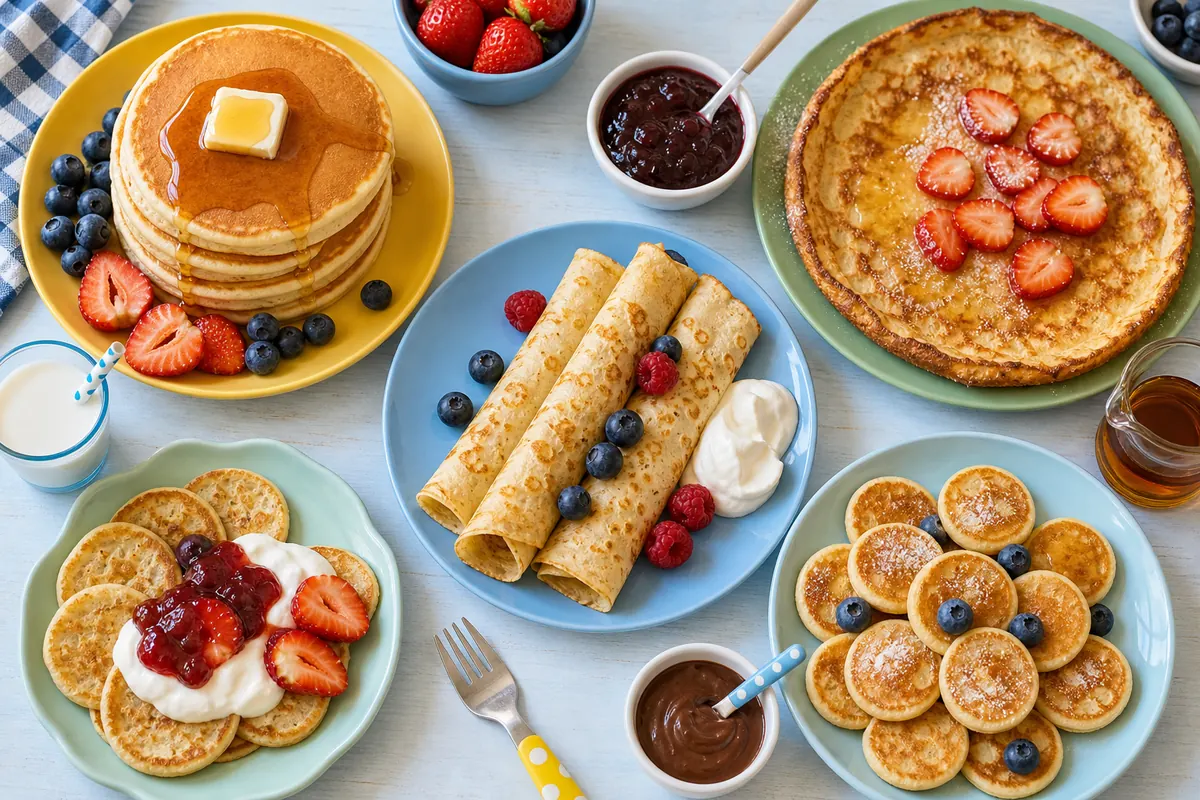
Almost every food culture has some version of the pancake: a simple batter poured onto a hot surface and cooked until set. The ingredients are cheap, the technique is easy, and the result can be sweet or savory, thick or paper-thin. It is little wonder that pancakes appear in so many kitchens, and that children are so often the first to ask for them.
An old idea
Griddle cakes are among the oldest cooked foods. Long before ovens were common, people mixed ground grain with water and cooked it on a hot stone or flat pan. The word pancake itself appears in English in the 15th century, and cooks in medieval Europe made batters from flour, eggs and milk much like the ones we use today. For a broader overview of the many forms the dish has taken, the Pancake article on Wikipedia is a useful starting point.
Because pancakes need no oven and little equipment, they became everyday food for people everywhere. They were also tied to the calendar. In many Christian countries, eggs, butter and milk were used up before Lent began, which is why Shrove Tuesday, also known as Pancake Day in the United Kingdom, is still marked with pancakes.
Thick and fluffy: American pancakes
The pancakes most Americans eat for breakfast are small, thick and fluffy. They owe their height to baking powder, which became common in home kitchens in the 19th century, and they are usually served stacked with butter and maple syrup. Their cousins include Scotch pancakes, also called drop scones, which are smaller and often eaten with jam.
Thin and rolled: European traditions
Across much of Europe, pancakes are thin and flexible, closer to the French crêpe than to the American stack. In the Netherlands, pannenkoeken are large and eaten for dinner, often topped with bacon, cheese or apple. In Hungary, palacsinta are rolled around jam, sweet cottage cheese or cocoa. Many other countries have close relatives: Germany has Pfannkuchen and Eierkuchen, Sweden has pannkakor, and Russia has blini and thin bliny served with sour cream or caviar.
Thin pancakes make a lot of sense when you think about it. A pan covered in a thin layer of batter cooks in a minute, and the finished pancake can be folded, rolled or stacked around a filling. A cook can feed a big family from a modest amount of flour and eggs.
Fermented and spiced: pancakes beyond Europe
Pancakes are even more varied outside Europe. In Ethiopia and Eritrea, injera is a large, sour flatbread made from fermented teff batter and cooked on a griddle, used as both plate and spoon. In India, dosa are thin crisp pancakes made from fermented rice and lentil batter, usually served with chutney and a lentil stew called sambar. In Japan, okonomiyaki are savory pancakes made with shredded cabbage, and dorayaki are two small sweet pancakes sandwiched around red bean paste. In Korea, pajeon are crisp scallion pancakes.
These dishes show that the same basic idea of batter on a hot pan can lead to very different flavors and textures, depending on local grains and tastes.
Tips for pancakes at home
Whatever style you choose, a few rules hold true:
- Let the batter rest for at least 15 minutes. The flour absorbs the liquid and the pancakes are more tender.
- Do not overmix thick pancake batter. A few lumps are fine, and overmixing makes them tough.
- Heat the pan properly before adding batter, and use a small amount of butter or oil each time.
- Expect the first pancake to be a test. It is normally the one that goes to the cook.
Pancakes also make an easy way to introduce children to cooking, since the batter is simple to whisk and the flipping is endlessly entertaining. Pick a style from a country you have not tried and let your family choose the toppings. It is a quick way to taste a bit of the world without leaving your kitchen.